-

Factory Farming
Michael W. Fox
The information contained in this booklet will help you understand the methods by which your food animals are raised. These methods have come to be known as factory farming. It will also discuss the incredible magnitude of animal suffering which has resulted from treating animals as nothing more than machines to produce more and more animal protein in these modern factories.
-
Animals in Education: The Use of Animals in High School Biology Classes and Science Fairs
Heather McGiffin and Nancie Brownley
ANIMALS IN EDUCATION is the proceedings of the conference, "The Use of Animals in High School Biology Classes and Science Fairs," held September 27-28, 1979 in Washington, D.C. which was sponsored by The Institute for the Study of Animal Problems, 2100 L Street, N.W., Washington, D.C. in connection with The Myrin Institute for Adult Education, 521 Park Avenue, New York, N.Y. 10021.
-
The Humane Society of the United States 1954-1979: Twenty-Five Years of Growth and Achievement
Patrick B. Parkes and Jacques V. Sichel
The HSUS came into being because, for several years previously. a great many people throughout the United States were aware of the tremendous need for a strong humane group that would actively endorse and work towards eliminating, on a national scale, some of the more obvious cruelties and injustices imposed on animals in slaughterhouses and by uncontrolled breeding of domestic pets. They also realized the necessity for a humane organization that would act in a missionary role. to encourage and assist in the formation of humane societies in the thousands of towns and areas where none existed.
-

Euthanasia of Dogs and Cats: An Analysis of Experience and Current Knowledge with Recommendations for Research
T. Carding and M. W. Fox
1978 Special Report prepared by the Institute for the Study of Animal Problems
-
The Power of Positive Programs in the American Humane Movement
The Humane Society of the United States
Discussion papers of the National Leadership Conference of The Humane Society of the United States
October 3-5, 1969 / Hershey, Pennsylvania
-
The Humane Movement - 1966
The Humane Society of the United States
Selected discussion papers of the National Leadership Conference of The Humane Society of the United States
September 24-26, 1965
-
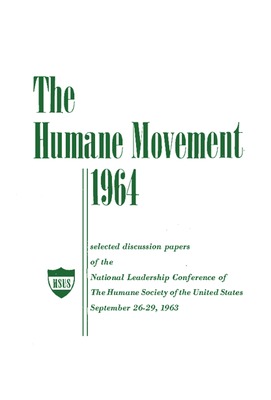
The Humane Movement - 1964
The Humane Society of the United States
Selected discussion papers of the National Leadership Conference of The Humane Society of the United States
September 26-29, 1963
-

Humane Education
Lillian Maude Mathewson
The purpose of this thesis is to present an analysis of the developement and present status of humane education in the United States, its administration, aims, and methods. The field of humane education has this peculiarity, that while it has gained almost universal recognition as an important element in the child’s experience, it has as a general rule been provided not by the school itself but by an outside agency in cooperation with the school authorities. The reference is to the work of numerous state and city humane societies who have carried on as a part of their activities a program of education.
-

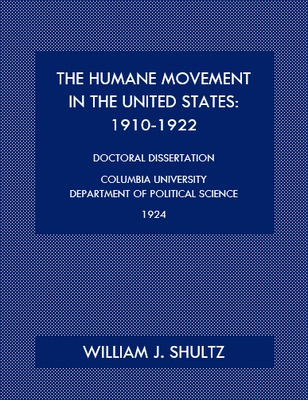
The Humane Movement in the United States: 1910-1922
William J. Shultz
This study attempts to continue for the brief period from 1910 to 1922 Professor Roswell C. McCrea's descriptive survey of the Humane Movement in the United States, which covered the distinctive features of legislation and organized efforts for animal and child protection. Professor McCrea gave an outline presentation of the historical background and development for at least a generation prior to 1909-1910. While making free use of Professor McCrea's materials and in some cases restating his conclusions, I have made no attempt to cover the same ground, but have begun this study with the year 1909-1910 where he left off.
Printing is not supported at the primary Gallery Thumbnail page. Please first navigate to a specific Image before printing.