-
In-Service Teachers’ Understanding and Teaching of Humane Education Before and After a Standards-Based Intervention
Stephanie Itle-Clark
The purpose of this study was to examine the ways in which credentialed educators conceptualized, understood, and perceived humane education, as well as their intent to include humane education in personal practice and their knowledge of strategies for integrating humane education concepts into their classroom work. The group of 25 educators participated in an online eight-week professional development course and completed pre- and post-surveys. The participants consisted of educators from the United States, British Columbia, and Vietnam. Participants were 11 secondary educators, 10 primary educators, 2 substitute teachers, 1 administrator, and 1 librarian. Results indicate that after an eight-week professional development intervention, participants had a greater understanding of humane education and an increased intent to include humane concepts in their practice, as well as increased knowledge of strategies for integrating humane concepts into their personal work. Results show that while the educators did not have an understanding of humane education at the beginning of the study, the humane themes resonated with their desire to engage students and to teach prosocial behaviors. A recommendation is for educators to receive humane education professional development that aligns with reform models and standards-based education in order to increase their knowledge of strategies and to infuse humane education into traditional pedagogy.
-
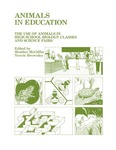
Animals in Education: The Use of Animals in High School Biology Classes and Science Fairs
Heather McGiffin and Nancie Brownley
ANIMALS IN EDUCATION is the proceedings of the conference, "The Use of Animals in High School Biology Classes and Science Fairs," held September 27-28, 1979 in Washington, D.C. which was sponsored by The Institute for the Study of Animal Problems, 2100 L Street, N.W., Washington, D.C. in connection with The Myrin Institute for Adult Education, 521 Park Avenue, New York, N.Y. 10021.
-
Humane Education
Lillian Maude Mathewson
The purpose of this thesis is to present an analysis of the developement and present status of humane education in the United States, its administration, aims, and methods. The field of humane education has this peculiarity, that while it has gained almost universal recognition as an important element in the child’s experience, it has as a general rule been provided not by the school itself but by an outside agency in cooperation with the school authorities. The reference is to the work of numerous state and city humane societies who have carried on as a part of their activities a program of education.
Printing is not supported at the primary Gallery Thumbnail page. Please first navigate to a specific Image before printing.